Model
Understand the psychology, strategy or existing idea behind the problem.
A field guide to better odds
Psychology, strategy, real-world experiments and humor for people who refuse to stay stuck.
Life rarely gives you certainty. It does give you odds. We study how people make better decisions, take difficult action, recover from failure and tilt those odds in their favor, without pretending that a morning routine can make you invincible.
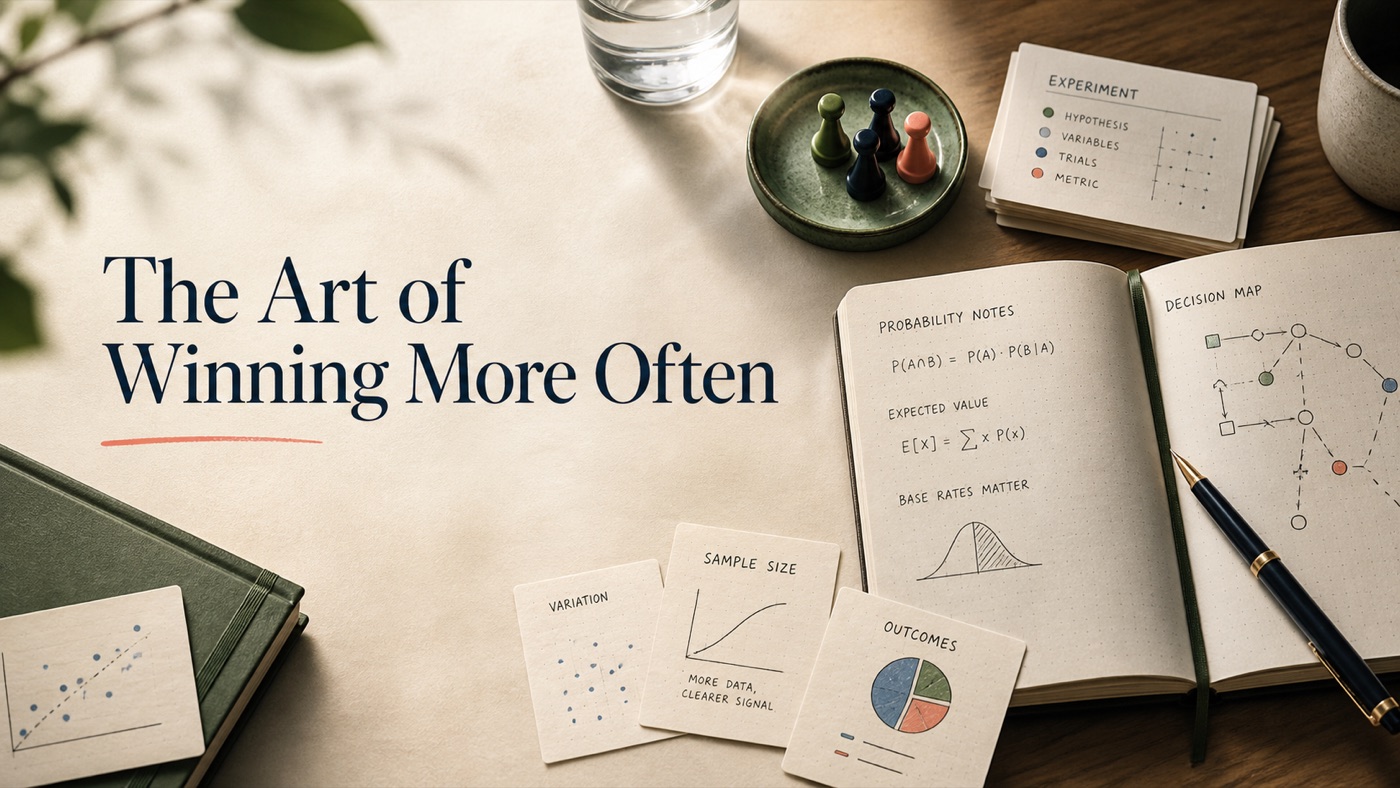
What winning means
Winning is not dominating everyone around you. It is making progress toward an outcome you deliberately chose, without lying to yourself or making someone else smaller.
Sometimes winning means starting when you normally stall, finishing something you are afraid to release, having the difficult conversation or recognizing that you are playing the wrong game.
And sometimes winning means losing cheaply enough to try again.
The method
Every practical article turns an idea into one concrete action small enough to try in real life, then observes what changed.
Understand the psychology, strategy or existing idea behind the problem.
Turn the idea into a practical action instead of a personality renovation.
Keep what worked, adjust what almost worked and retire what collapsed.
What we explore
Psychology
Strategy
Experiments
Postmortems
Featured field notes
Evidence policy
Useful ideas deserve more than confident typography. Articles clearly distinguish research-backed findings, promising but uncertain ideas, field-tested methods, personal observations and pure speculation wearing a respectable jacket.
About
I am Mahammad. My work has trained me to think in experiments: form a theory, make a move, measure the result and resist the temptation to call luck a strategy.
This is where I examine established ideas, invent new ones, test what can be tested and report what survives contact with reality. It is a workshop, not a pulpit.